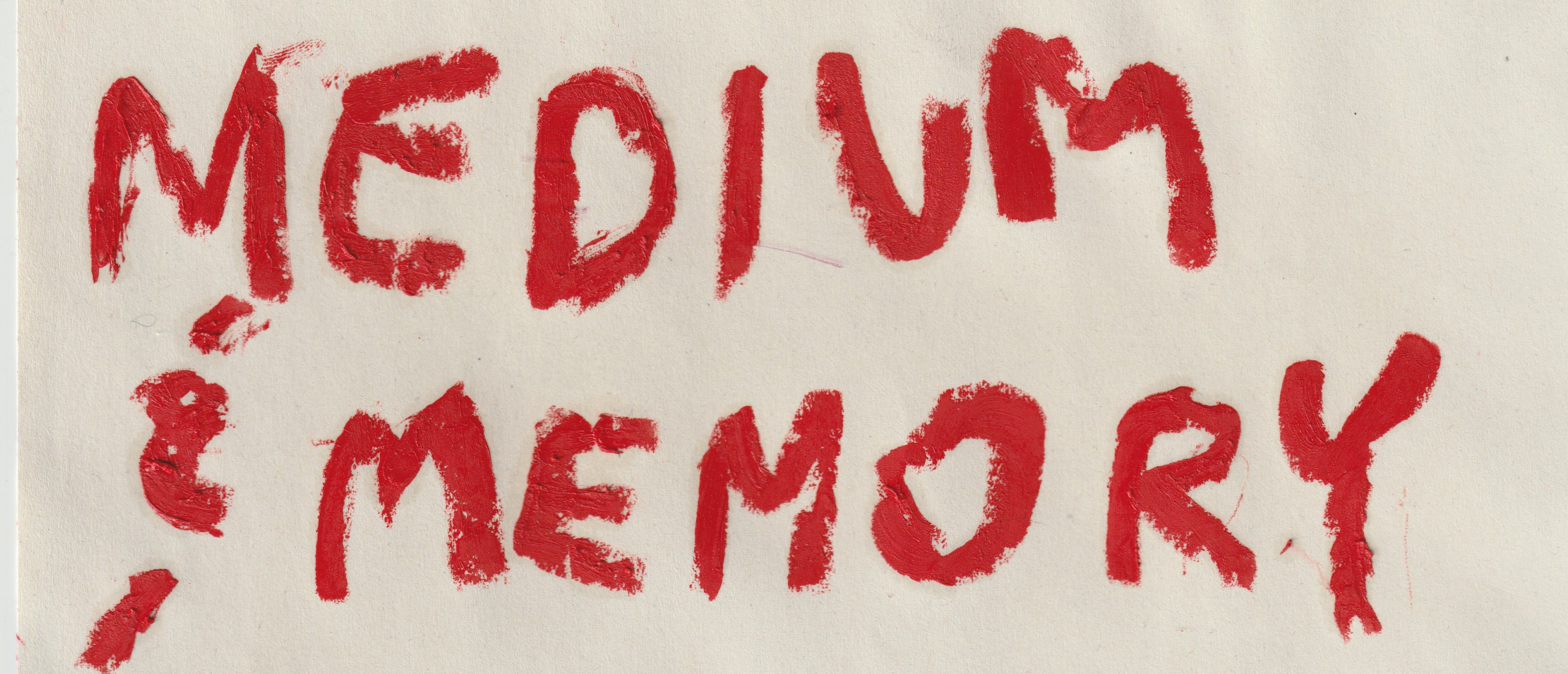
Medium & Memory
Learning to Remember Through Touch and Color

There are large parts of my childhood I don’t fully remember. Much of it feels suspended and distant. To me in many ways my earliest memories are like oil pastels, fragile, smudged, easily altered. There are things that I remember very vividly, there are things I think I remember but maybe they were stories that were past down to me, memories that aren’t really my own, and there are things that have become so blurry I don’ feel like I have the tools or mediums to navigate through fog. Sometimes it’s a piece of something, a detail, a texture, a fragment that transports me to a place I am vaguely familiar with, something tangible in the now, that I can’t quite pin point what that familiarity is. Like as if I was holding random pieces of a puzzle that don’t fit together but I can still, instinctively, arrange them in a way that forms a picture, but I am still unable to tell from what time, or place, or maybe even what dream did that piece come from. Sometimes I wonder if I only really began living around five years ago, when I chose to become an artist.
I was born in Brazil, but part of my family has always lived in Paris, we visited them almost every year. My mother was an artist and in our homes, (there were many), there was always room for art materials, even the ones she didn’t use for her own work. She was a textile artist, a watercolorist, and a writer, and spread around the home, we would have drawers filled with colored pencils, rulers of all shapes and sizes, papers for all mediums, boxes full of oil paint, and gouache, we would have spray paint and glue and even miniatures for maquettes that were never made.
When we traveled, amongst souvenirs and trinkets; we made sure, she made sure, we brought home books, brushes, pencils, paints. Our luggages always came back filled to the brim with color.
In Paris, there were sacred stops, places we had to visit to confirm we had truly arrived. One of them was the Sennelier art store by the banks of the Seine. I don’t remember if I ever bought anything there for myself, but I remember the reverence my mother held for that place. It wasn’t just a store, it was a shrine. A temple of pigments and old-world craftsmanship. She used to say they didn’t make art materials like that anymore. That the richness of Sennelier was disappearing from the world, and we as mere disciples of the craft, had a duty in paying our respects to that place.
And now, all these years later, oil pastels, Sennelier oil pastels specifically are the material I use most in my work.
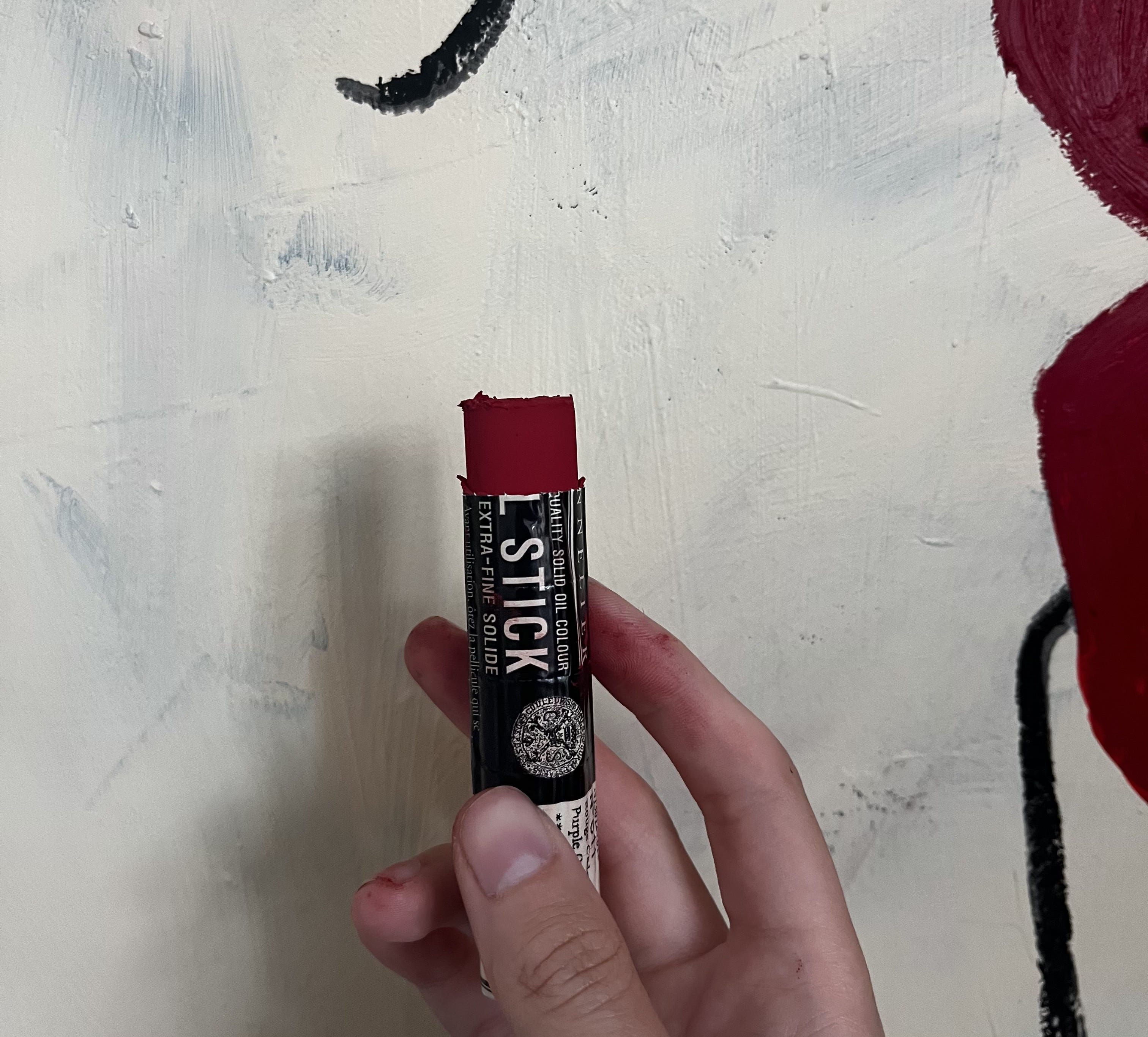
For a long time, I was afraid to use oil as a medium in my work. It felt too official, too grand, too bound to tradition, the one medium that I as a self taught artist would couldn’t really conquer. I never meant to take them seriously. They arrived like a flirtation. Maybe because I didn’t go to art school, I never learned the rules, or the appropriate way and order of how to do things, and so I never felt obligated to follow them. Which also meant that, within this freedom of not knowing, there was also my fear of not knowing enough, so I found every single excuse to not add oil as a medium in my roster of tools. Almost like a rebellion, I acted as if I didn’t need them in order to make my work feel grand, serious, and important. I learned about how to use materials not through method, but through play and challenge. And so I slowly approached oil pastels like how you might approach a new lover: curious, hesitant, drawn in by instinct. When I first started working as an artist, I spent a long time saying to myself and to others that I never really meant to become an artist, that a snowball effect had taken over the trajectory of my life, so I guess, looking back on all of this now, I was not afraid of oil, but afraid of myself. Of making myself “official” (for lack of a better word), of taking myself as seriously as a medium as oil, of doing something and meaning it, having something to show for. Afraid of creating something that others would see, interact with, remember, and ultimately judge like I judged it myself. I was afraid of seeing me, a real me, showing it to others, and remembering it.
The first time I pressed this intimidating medium to canvas, it was a red oil pastel so rich it felt alive, more like a wound that was being cracked open. A memory being created. It reminded me of writing with lipstick on a mirror: urgent, intimate, impulsive. It wasn’t what I expected. I had always understood oil to be the most sophisticated medium, pristine, elevated, perfect. But this that I was experiencing was something else entirely. It was rebellion, very much like the rebellion I was enacting and using as a way to avoiding interacting with this medium in the first place. There was no clean line, no control. Just pressure and pigment. Just me and the canvas and this thick-bodied color that refused to be anything but itself.
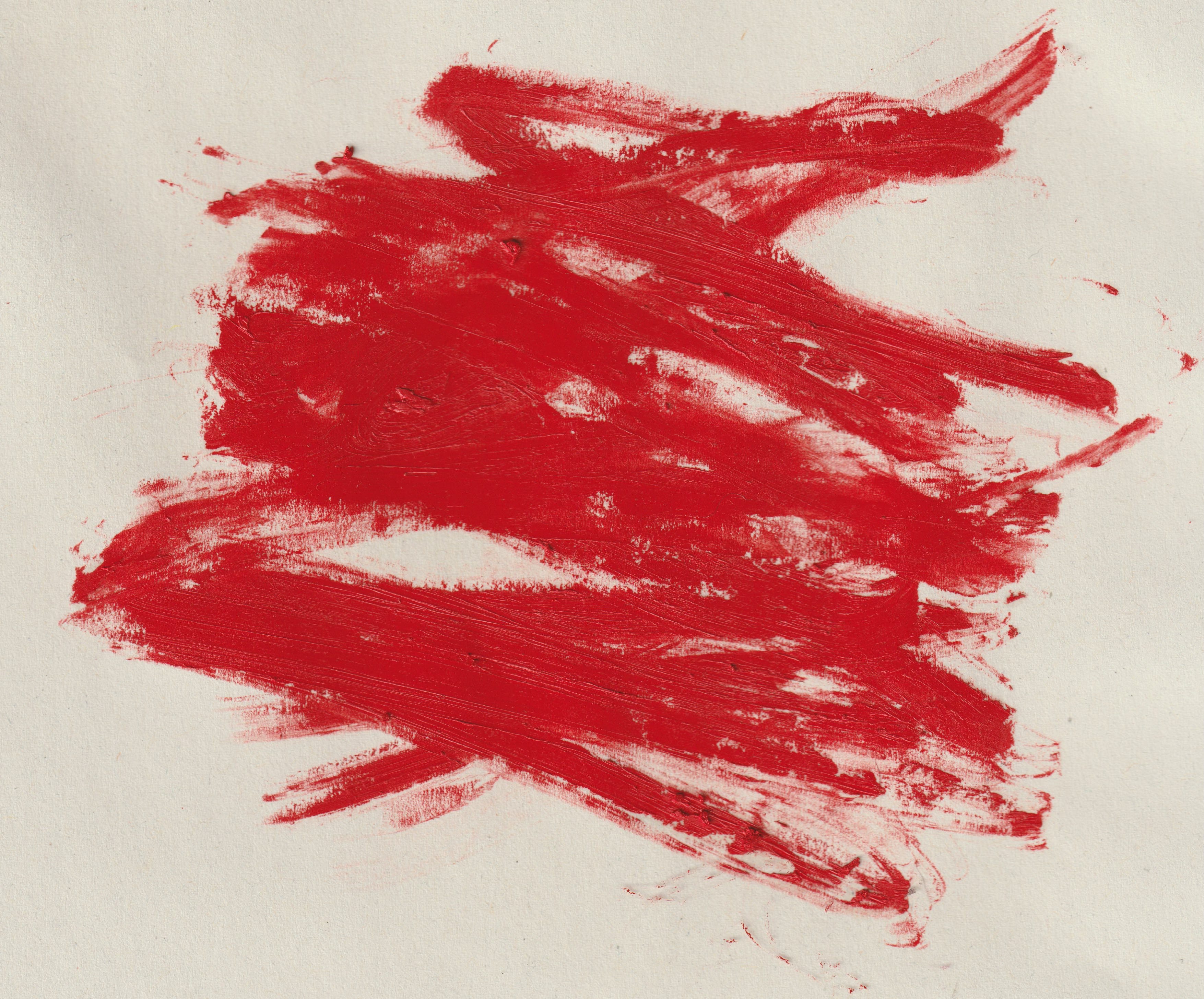
It reminded me of skin. Of makeup. Of childhood. Of something soft that stains. It reminded me of all the touches that have left traces on me, that softness that carries a weight.
Oil pastels made a mess of my expectations. And I started to see myself falling in love with the mess.
I grew up striving for perfection. Mistakes weren’t allowed. Emotion wasn’t welcomed, I did’t welcome it, I didn’t know how to. When I first began making art as my work, my first choice of medium was digital tools: easy to undo, easy to edit, easy to clean up, and ultimately, if I chose to I could delete everything with no traces left behind. But painting demanded something different. It demanded presence. It demanded that I change my relationship to error and to myself. Oil pastels, more than any other medium, forced me into a reckoning of change, like a mirror. My first experiments with paint still had a lot of digital influence in them, they still needed to be perfect, flat, without any sign of mistake, or emotion. It took me 2 nearly 3 years to make the transition from digital to painting, and into my current way of working, and even still, I keep zigzagging between these two sides of myself and how I work. In a way I am learning how to best used both tools in order to create a personalized system, a method of working that reflects my life, and my memories.
Oil pastels and sticks are blunt. Direct. It’s hard to fool them. You can’t trick an oil pastel into precision. You can’t finesse it into delicacy. It does what it does, and you either meet it there or you don’t. And in that resistance, I found a sort of freedom.
The crumbling edge, the unexpected softness, the thickness of the pigment, every part of them calls you out of your mind and into your hands. There’s no pretending. You can’t keep your distance. You have to touch. You have to smudge, to engage. You have to let go of what you thought perfection would be and accept what it becomes right in front of you.
This is a medium that has now become a kind of badge in my practice, the pastels leave a mark. On the canvas, yes, but also on you, on me. I’ve always taken pride in leaving the studio dirty. Covered in color. It’s proof I gave myself fully to the work, that I managed to challenge patterns of behavior that kept me from being true to myself. A memory that I abandoned something of myself in the process of painting and like the oils, left my mark on something as they left their mark on me.
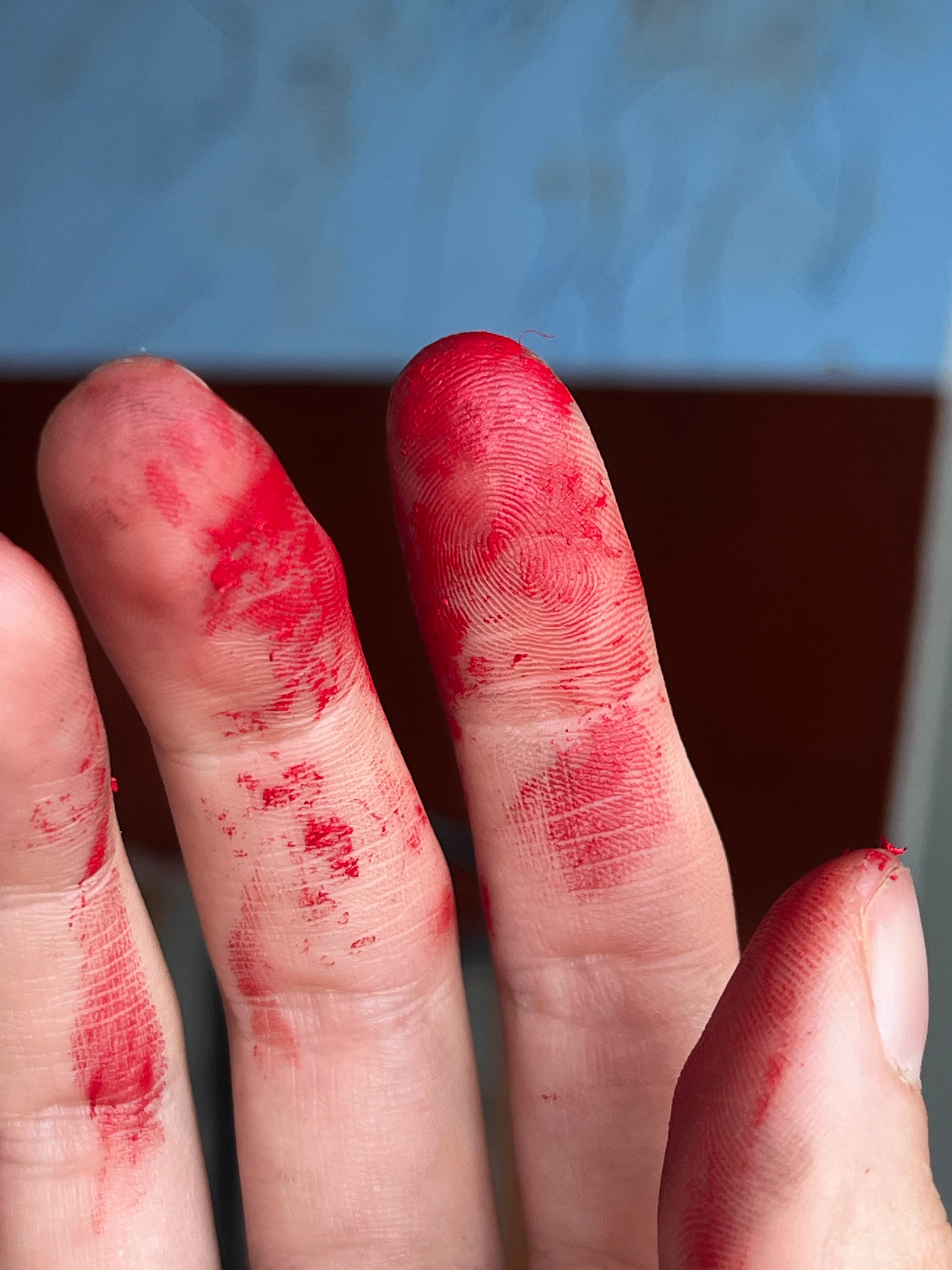
A residue that says: I was here, and I will remember this.
They’ve taught me to follow the accident, to stop polishing things into submission.
They taught me to remember.
They want my fingers involved.
They want the intimacy of touch.
Even when I don’t use my hands directly, I become the brush.
Even after I wash my hands, the color stays beneath my nails. Oil pastel refuses to leave quietly. It lingers like a scent, like a bruise, like a reminder.
A reminder that I am an artist now. That I am not afraid anymore.
That I must keep going.
That maybe, through all this color and pressure and smudge, I am remembering now what I couldn’t hold onto from before.